Maths
At Northdown Primary School, we work in partnership with Mathematics Mastery (Ark Curriculum Plus) and follow their programme of study. Together, our mission is to enable all learners to enjoy and succeed in mathematics. We want learners to be equipped with an understanding of Mathematics that will be relevant and useful in their future studies and in the world of work.
The Mathematics programme is based on three core principles: to provide learners with a deep conceptual understanding of mathematics, the ability to confidently communicate in precise mathematical language, while becoming mathematical thinkers. We are confident that if a pupil understands the core principles, they will be able to remember more and do more maths, within whichever context they encounter it.
The underpinning principles for our curriculum are high expectations, modelling, vocabulary rich lessons and the teaching of fluency and reasoning.
Implementation:
Every class from EYFS to Y6 follows the Mathematics Mastery scheme of learning. Lessons are personalised to address the individual needs of the current cohort and requirements for the mixed year group classes but coverage is always maintained. Most Mathematics lessons are split into six-parts. This six-part lesson gives a structure through which to implement the pedagogical principles of the curriculum. The different parts of the lesson allow teachers to bring the different dimensions of depth to the foreground. Having a consistent structure for each lesson ensures that learners are exposed to the pedagogies associated with each dimension.
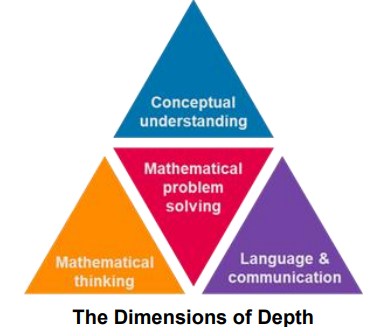
The Dimensions for Depth are the core principles in our Mathematics Mastery programme and underpin every lesson.
-
Principle 1. Conceptual Understanding Mathematics tasks are about constructing meaning and making sense of relationships. Learners deepen their understanding by representing concepts using objects, pictures, symbols and words (CPA Approach).
-
Principle 2: Language and Communication Mathematical language strengthens conceptual understanding by enabling pupils to explain and reason. The content of our curriculum carefully progresses in order to induct learners into the mathematical community. This often starts with more informal language initially, building up to formal and precise mathematical language. Talk tasks are part of every lesson in the curriculum to help with this development.
-
Principle 3: Mathematical Thinking Our curriculum is designed to give learners the opportunities to think mathematically. Throughout the curriculum, tasks are set that require learners to specialise and generalise, to work systematically, to generate their own examples, to classify and to make conjectures.
We implement our approach through high quality teaching delivering appropriately challenging work for all individuals. To support this, we use a ConcretePictorial-Abstract (CPA) approach to teaching mathematical concepts. Reinforcement of learning is achieved by going back and forth between these representations, building pupils' conceptual understanding instead of an understanding based on completing mathematical procedures.
- Concrete - the doing: A pupil is introduced to an idea or a skill by acting it out with real objects. This is a 'hands on' component using real objects and it is the foundation for conceptual understanding. 'Concrete' refers to objects such as Dienes apparatus, fraction tiles, counters, or other objects that can be physically manipulated.
- Pictorial - the seeing: A pupil may also begin to relate their understanding to pictorial representations, such as a diagram or picture of the problem.
- Abstract - the symbolic: A pupil is now capable of representing problems by using mathematical notation, for example: 12 ÷ 2 = 6. This is the most formal and efficient stage of mathematical understanding. Abstract representations can simply be an efficient way of recording the maths, without being the actual maths.
Maths Meetings are a vital part of our maths teaching and are used to consolidate key learning away from the point when a concept is introduced. Each Maths Meeting lasts around 15 minutes and they happen regularly throughout the week.
Each year group in school from Reception to Year 6 participates in Maths Meetings. Maths Meetings provide an opportunity to teach and revise 'general knowledge maths' which may not explicitly be covered during the maths lessons that week, such as telling the time, and also allows the daily integration of maths into the surrounding environment.
This means that children are practising concepts and skills on a regular basis, ensuring they are continually building on their mastery of these concepts. Maths Meetings are a fantastic way for staff to support children with consolidating their knowledge and pre-teaching upcoming concepts, ensuring they are confident with skills required for the upcoming lesson.